Leveraging Surprise


So I want to blog whenever I learn something. Managing a blog post and giving credit to the source: those activities push my fresh learning deeper into my mind. They get documented! I leverage blogging to learn, just as Pablo is leveraging surprise to share news.
 David Epstein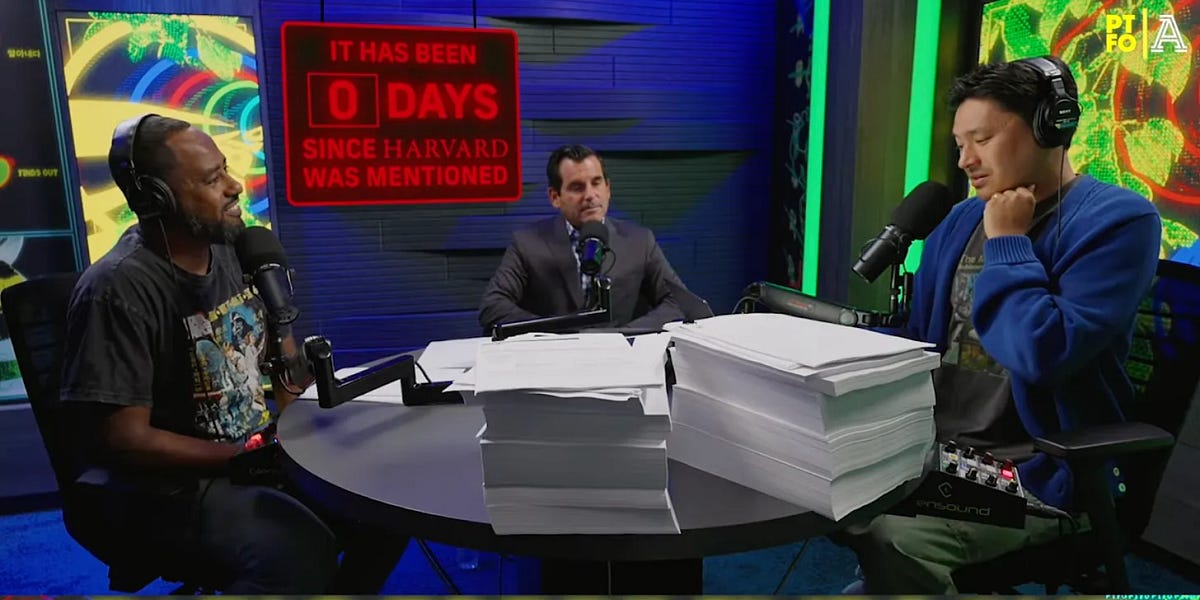
Pablo Torre, in our chat below about his podcast, Pablo Torre Finds Out
PT: So a lot of this is about preserving surprise in an era in which surprise, I think, has been really eaten away by the basic premise of the algorithm. And not to be highfalutin here, but we’re living in this age when the algorithm just gives you stuff that you’ve already expressed that you want. And so my whole thing is that surprise, as a concept, has never been more valued, even as it becomes difficult to surface it. So to me, I take that down to the most granular level, in which I don’t tell the people I’m doing these episodes with what is in the box in front of them, and so they’re fundamentally mystery boxes, or sometimes manila folders in which I’m guiding them on a sort of directed tour—sort of a way through a story in which they personally get to discover what I have found in a way that the audience gets to join them for. So it is not merely that they are learning for the first time—rhey’re learning for the first time authentically on camera, being surprised in public. And so what I’ve realized is that the viewers really do get to live vicariously through them, which means they get to laugh and sweat and get nervous and get frustrated and sort of have these revelations such that the audience is feeling a part of it as well from afar.
...
DE: I wrote a bunch in Range about how analogies are incredibly powerful for innovation. You can take the structure of a solution to a problem in one area, and you bring it over to another place, where, even though it’s not new to the world, it’s new in that place. And that is very often how innovation works—solutions jumping boundaries by way of analogy. And since I see what you’re doing as an innovation in investigative storytelling, can you talk a bit about the analogy you were using when you came up with this format?
You can take the structure of a solution to a problem in one area, and you bring it over to another place, where, even though it’s not new to the world, it’s new in that place.
PT: Yeah, so what inspired it was this genre of video on YouTube that, initially, when I saw it, was so jarring that it kind of shook my faith in whether I could even make content on the internet.
DE: When are we talking here, like pre-Pablo Torre Finds Out?
PT: Yes, absolutely. I’ve always marveled at the unboxing video as a genre, specifically because there is a YouTube creator who I believe was at one point, and may still be, like the top-grossing creator on the entire platform. His name is Ryan. His channel’s name was Ryan ToysReview, and he was a child. And so this child was making, like NBA max contract money annually—...
And I started thinking about: Why do people like watching this? On some level it’s more than insane, it’s depressing. It’s like, one of the most popular genres of YouTube video, the platform that is the most popular video platform in the world, is one in which we’re just watching this kid open toys over and over again? What is the point of this? And then I just realized that a lot of it is the vicarious enjoyment of watching someone else be surprised, and amused, and frustrated, and genuinely so excited to find out what’s inside this thing. And what I started thinking about was: Instead of fighting this apparent human dynamic—in which we do love watching other people experience something like that—what if, instead of fighting it, I kind of embraced it?...
There’d be a difference between me coming back from a reporting trip and telling my friends, “You won’t believe what just happened,” versus the top of a magazine feature in which I was trying to effectively channel this institution [Sports Illustrated]—which was certainly a master of the genre—but I found myself often not starting with the thing that I would tell my friends about in real life. And sometimes, even worse, it wouldn’t get into the story at all. I just wouldn’t put it in the story because it didn’t fit the rubric I had in mind. And this show [Pablo Torres Finds Out] is really designed to make sure that the experience you get as a listener or as a viewer is most like what it might be like to be friends with me. And so the best way I thought to do that would be to literally put my friends in the position of these little psychological experiments in which they don’t know what’s coming and they don’t have to act or perform it. They just have to trust me.